skip to main |
skip to sidebar
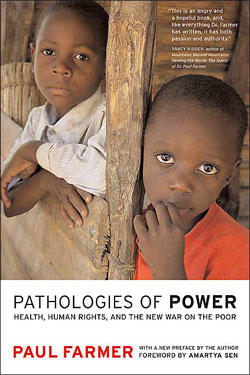
Paul Farmer is a doctor of medicine. He has worked all over the world with the dispossessed, the sick, the dying and most of all with the poor. Farmer is among the few medical professionals who as well as giving his time to those who are less fortunate than us has set about to attack the institution that keep these "pathologies of power" in place. What Farmer gives us with this book is anecdotes of patients of his from all over the world as well as statistics that put the public health system in these countries to shame, and put the rest of us to shame as well for allowing this to go on.
Throughout this book, Farmer exposes the very institutions that benefit most from a health system that fails literally millions of people. He expresses frustration where an easily solvable problem in medical terms is unable to be solved because the appropriate drugs simply aren't available. Diseases such as tuberculosis, which are curable in the vast majority of cases with relatively inexpensive drugs. It is largely because these drugs are not available that medical professionals have seen a huge increase in the amount of cases of multi-drug-resistant TB. These are especially telling in prison populations, where often a prison sentence can also become a life sentence.
Furthermore, Farmer expands on this to confront why medical ethics courses largely stick to the plight of those with the fortune to be able to access the right drugs or even to be able to sign their rights away. He sees public health as essentially lacking even among organisation such as the World Health Organisation. More than anything this book stands as a call to action for those of us who find it easier to turn a blind eye. It is both personal with a large amount of anecdotes and statistically sound in its reproduction of the plight of people all over the world.

This is an astonishing memoir of growing up in Catholic Ireland. I read this at about age 12 and loved it all through high school and decided it had been a good couple of years since I had read it so read it again.
The novel starts off with a four year old Frankie in the USA, and he tells the story of his very young years. His mother comes to the USA for a new life, before meeting Frank's father Malachy and Frank is born only a few months after his parents' marriage rendering him a bastard. The family moves to Ireland when Frank's little sister dies as just a baby. They travel through Dublin, visiting Malachy's family and end up in Limerick. The next part of the story chronicles growing up with an alcoholic father and surviving with not enough money for food and relying on grants from various Christian foundations and 'the dole' as well as living assistance where possible and IOUs from the grocery store down the road. The thing that makes this memoir so heartbreaking is that it is written from the perspective of his young self. Frankie tries to model himself on the masculine figure his father never was and is constantly under the watchful eye of his Catholic God and spends a lot of time in confession. He finds himself rejected from local high schools because of the family's low social status, rejected from being an altar boy despite knowing the Latin phrases back to front. His family are at constant threat from "the typhoid", "the galloping consumption" and other illnesses which are not made less likely when the family moves next to a sole lavatory in a street where sewage is emptied from the other houses in the lane daily.
The book continues as Frankie struggles as a 13 year-old to make a life for himself, with the over and above goal of leaving Ireland for the USA, he makes his living firstly as a telegram boy and then as a magazine deliverer. An especially amusing part of the book is when one of the magazines they deliver accidentally has a page advertising contraception, Frankie is made to rip out the pages of the magazines where they have been delivered, not having a clue what contraception is and sells these scandalous pages for a profit.
The Irish lilt is noticed throughout and this is something that draws the reader even more into Frankie's life and his dedication to becoming something different than his upbringing would have him believe. His father's Dublin accent is scorned throughout by the other families in the area. McCourt truly had (he died recently) a great gift for writing and for displaying events as they happened in his mind at the time which is something a lot of memoirs struggle with. This remains on my list of favourite books. I highly recommend it.


