01 February 2011

Te mana, te kawanatanga: The politics of Maori self-determination by Mason Durie


This impressive book sets out Maori aspirations for more political, economic and cultural self determination in the face of ongoing settlements with the Crown. Durie discusses this self determination under six distinct headings which are separated as chapters. These are: the environment, cultural identity, social policy, land issues, fisheries and the Treaty of Waitangi. In each of these areas he looks at the power historically held by the Crown and also looks to more recent developments which have influenced Maori relationships with the Crown.

As well as this the book is aspirational about what could be offered to Maori in the future and how this can be extracted through the current framework of the public sector. By the end of the book, ideas for how tino rangatiratanga can best be offered to Maori is shaped within possible future governance and sovereignty structures. He offers the idea that sovereignty can be maintained both at a tribal level and at higher levels of governance, allowing for both arguments which have traditionally been the focus of much debate.

Through this, Durie focuses on the 1835 Declaration of Independence by Maori iwi as an important constitutional document alongside the Treaty of Waitangi. He sees the sovereignty aspired to by Maori as existing within and not apart from the wider nationhood of New Zealand.

This is a very well written and argued book. I highly recommend it to anyone interested in Maori and constitutional law in New Zealand.

Animal liberation by Peter Singer


This book, written in the 1970s is a well-structured account of the arguments for animal liberation. Singer's arguments are put forward in a way that starts on a premise that the majority of people would agree with. Arguments are then set out which clearly lead to conclusions that are not perhaps as well-regarded. Singer's philosophy is flawless and his arguments are convincing.

Singer has written a more recent book which I plan on reading when I get the chance. The only complaint I would have about this first book is that much of the evidence it uses is now vastly outdated and it's hard to tell what is still in use and what is not. Moreover, there has been a huge boom in factory farming in recent years which would possibly make many of his arguments even stronger. I look forward to reading his most recent book where I would assume newer evidence has been used.

The main argument Singer uses in this book is that of Jeremy Bentham, that is: "can it suffer?" Singer offers ample evidence of the pain that animals clearly feel being kept in cramped cages, being branded as a farming procedure, untreated injuries and a lot more. He asks why we are willing to inflict such pain on animals when we would not do so ethically on humans. He labels this speciecism, forcing us to confront that we base this strange ethic on nothing other than the fact that these animals are different species than us.

I highly recommend this book. Even though I would not go quite as far as Singer in some respects, I think he puts forward an argument that is persuasive and difficult to ignore.

30 January 2011

The Extravagant Universe by Robert P. Kirshner


This book tells the story of the team who came to a conclusion based on Type 1A Supernovae data that the expansion of the universe is accelerating. This is out of a choice of three models - either that it is slowing down due to gravity and will eventually come to a stop before collapsing in on itself and culminating in a "big crunch." The second option is that the acceleration of the universe is constant and it will keep expanding at the same rate. The third is obviously the one which was proven by their data - that the expansion of the universe is in fact accelerating.

The team (known as the High-z Supernova Search Team) used large telescopes to look for type 1a supernovae. This kind of supernova is rare - there is approximately one per galaxy per century, but since the universe is pretty big, high powered telescopes can be used to find these and measure their redshifts (redshifts mean they are moving away, blueshifts moving towards us). Kirshner has recounted the methods the team used and the other team they were competing with. He has also looked at how a variety of different universities across several countries colluded to get these results.

Kirshner has tried to keep this book relatively unscientific. In other words, it is made for the lay-reader and written so the wider public can understand how this operation played out, what it means and its ramifications for modern physics. In this mission, he did a relatively good job. It seemed sometimes like he was trying a bit too hard to amuse the reader with amusing anecdotes and jokes. Although this was a good idea, it was a little too often and came across or desperate. The book was highly interesting without this added information.

I thoroughly enjoyed it and recommend it to anyone interested in what's going on in the world of science.

Bodies by Susie Orbach


Susie Orbach famously acted as a therapist to Princess Diana and wrote Fat is a feminist issue. As well as this, she was one of the driving forces behind Dove's "real beauty" campaign of recent times. In this most recent book, Orbach has explored the changeable nature of our bodies in the 21st century. This includes the changes in BMI, the new surgeries available all over the world and the fight to look Western with eye surgeries in Asia, leg shortening procedures in Scandinavia and phalloplasties, which I'm sure I don't have to tell you about.

Through all of this new technology, Orbach confronts the reader to explore our relationships with our bodies. Through this, she demonstrates how the media has an influence on the way we view our own bodies. With evidence, including the amount of digitally manipulated images we see per day, Orbach makes it clear that we are underestimating the role of the media and the environment in these self-perceptions.

As usual, Orbach has provided a well-written and evidenced account that is both persuasive and thought provoking. I would have preferred if the book had been a bit longer or a bit more detailed, but as it was which was a relatively small book, it could serve well as part of a larger series.

I thoroughly recommend it.

Wasted by Marya Hornbacher


I had actually read this book before a few years ao. There is no doubt in my mind that Hornbacher is an incredibly gifted writer and the fact that she wrote this book at such a young age is testament to this. Now with two other books to her name, both of which I have read I thought I'd read this one again.

Wasted documents Hornbacher's descent into bulimia as a child and her struggle to gain some control over her behaviours which flip-flop between anorexia and bulimia. She gives a unique insight into the life of someone whose life is governed by starvation, binging, purging and a battle with her own mind that never seems to end. Hornbacher was offered an ultimatum when she entered hospital: continue to die or accept the help she so desperately needed and learn to live. She chose the latter and we get the impression in the opening pages of this book that she has remained relatively healthy ever since.

I do have a couple of complaints about this book. Firstly, she constantly documents her weight at different stages throughout her illness. This struck a note of competition that is often seen between eating disordered patients. It could be argued that this reflects her mindset at different stages throughout the book. That is, her mind revolves aorund the number she sees on the scale. However, these numbers could be incredibly triggering for anyone with an eating disorder who reads the book. It also focuses on weiht as a measure of the seriousness of her eating disorder, which while seemingly logical is not necessarily helpful.

I have read two other of Hornbacher's books: one is another memoir about her diagnosis of Type I (rapid cycle) Bipolar disorder and the other is a fictional book about grief. Both were more maturely written than this one was and it seems her writing is only improving.

I look forward to her next book.

07 January 2011

Edinburgh by Alexander Chee


I can't say this or that that was the reason. There is no reason and every reason. Why do you want to die, I ask myself. How else does it stop? If I die, the trouble stops with me. I can see her, Tammamo, her hand closing her husband's eyes, breathing in the air to make the fire-breath, his family, watching her. Enough, she'd be thinking. Fire on her lips. It ends with me now.
...
Coe walks in to my room. Wake up, he says. Time for practice. The clock reads 6 A.M. We've joined the crew team. I pull back my covers and dress quickly in clothes Coe helped me pick: we decided I could wear gray for exercise. We run the distance between Clark and the boathouse down by the river, more or less straight down the long hill of the campus. In the dark morning the sun is the gold centre of everything. Death feels far away in that instant, impossible. We arrive at the cold river as summer touches the beginning of its last days, and Coe smiles. The sun. Coe."
(p. 98)


My wonderful friend Vita recommended this book to me and it has to be one of the best reads of this year for me. Alexander Chee was little known to me as an author and a quick search reveals Edinburgh as his first and possibly only book. I hope he keeps writing. Edinburgh is written from the perspective of a Korean-American kid we know only as Fee. He joins a boy's choir where he and several other boys are molested by the choir director 'Big Eric' who picks on only boys who look a certain way. This includes Fee's secret love and close friend, Peter.

His life unfolds from this central event and the way in which Fee remembers and describes his abuse can be seen in the quote above. Fee is gay, but not because of the abuse, in fact it almost seems it is in spite of what has happened. Fee's life is affected hugely - he engages in a series of relationships at university as he sees his friends crumble around him (one even kills himself). Despite this, Fee manages to build a life for himself until he is confronted by a boy at the school he teaches, who reminds him far too much of a boy he loved in the choir.

This book is written amazingly and is both heart-wrenching and at times amusing. Chee has demonstrated an amazing and empathetic stance towards characters. At the same time, he hasn't denied them agency or taken away from their experience in any way. His literary phrase unfolds magically and he has the ability within this to provoke emotion in (I would say) most readers.

I really hope I read more from this author. This is the best fiction book I have read in a long time.

06 January 2011

The Brothers Karamazov by Fyodor Dostoyevsky


Having read both The Idiot and Crime and Punishment, I felt it was time to finally read this daunting looking i.e. rather large book, which I had bought cheaply at a book shop. It tells the story of three brothers: Dmitri, Ivan and Aleksey. The brothers are brought together when Dmitri returns to his father as a soldier to request money he believes is rightfully his. They decided to meet with Zosima who works in a monastery where Alyosha (Aleksey) is placed. From here the book explores philosophy, religion and politics and each of the brothers explores a different perspective. Another brother is added to the mix, when we discover that Pavel Smerdyakov was likely fathered by Fyodor. Pavel shares Ivan's atheist beliefs and appears to look up to him throughout the book.

The book also explores the responsibility of the different brothers towards each other and towards a more general good. This leads to the further analysis oh each character's philosophy and is guided by the early words of the Elder Zosima as well as the frenzied actions of Dmitri as he chases the woman he loves, Grushenka. Ivan's philosophy is forced to change from the complete rejection of morals with no God that he preaches at the beginning of the book. This is just one of many examples of the way different philosophies are explored in the book.

Like any great Russian novel, this one is full of extravagance. It contains well thought out characters and plot lines that keeps the reader guessing throughout the book. Dostoyevsky also lets the characters speak for themselves rather than explaining their actions or movements which aids the telling of the story.

I cannot do this book justice and I recommend it to all for its wonder and its amazingness and because it looks at important social issues in a unique way.

The Forest by Edward Rutherford


This was the last book I read of the several by Rutherford that were lent to me by a good friend. This book is about the New Forest of England and its history is told throughout generations. Most famously, King William Rufus was shot and killed in this forest in 1100 during one of his deer-hunting trips. Rutherford has played into this episode and added some of his own dramatic flair for storytelling to describe this particular event and its ramifications.

As in his other books, this one is dominated by a variety of interesting characters. The Albion family for example find themselves split down the middle in political affairs. On the death of Bloody Mary, Elizabeth I had come to the throne. The Lady Albion loudly despises the Queen and doesn't believe she should be on a throne. In this she wants the Catholic Spanish to invade in order to return England to the "true faith." Her son, Clement who works for the Queen tries in vain to silence her many times and is forced to choose between the faith he feels for his mother and the honour he feels towards the Queen.

Like all of Rutherford's books, this one is long, but keeps the reader interested with many interesting characters and historical events. The particularly magical part about this book is the the New Forest maintained its beauty and is now a historical reserve. In this way, Rutherford was able to build on what he already knew about the New Forest, one would imagine from visiting it.

I would definitely recommend this book to anyone, especially if you have an interest in history or have previously enjoyed Rutherford's work.

02 January 2011

Books to review

Right I have resolved to do at least one a day until I've caught up (it doesn't help that I'm rushing through books so quickly at the moment).
In order of completion:
The Forest - Edward Rutherford
The Brothers Karamazov - Fyodor Dostoyevsky
Edinburgh - Alexander Chee
Wasted - Marya Hornbacher
Bodies - Susie Orbach
The extravagant universe - Robert P. Kirshner
Animal liberation - Peter Singer
Te mana te kawanatanga - Mason Durie
The Outsider - Albert Camus
I'll take you there - Joyce Carol Oates
Resistance - Maria Bargh (ed.)
Fat is a feminist issue - Susie Orbach
The sirens of Baghdad - Yasmina Khadra
The Cult Files - Chris Mikul
The city is a rising tide - Rebecca Lee
AD: A memoir - Kate Millett
Born on a blue day - Daniel Tammet
Little girl blue: The life of Karen Carpenter - Randy L. Schmidt

London by Edward Rutherford


This book is quite possibly the longest of any of the ones I have read by Edward Rutherford. Like his other books, the title is the subject of this book. It stretches from the ice ages to almost the present day. Of course there are periods of a hundred or so years skipped here and there, especially in periods where little was known (The Dark Ages). Genetic characteristics passed down through generations are one of the interesting parts of the book. White hair as well as webbed fingers are particularly seen in one family who make an appearance as fairly central characters in different periods of the book. The family even endures a split down the middle and some characters do not know they are related and only guess through these genetic characteristics.

Some obvious critiques of this book are the ones that would be difficult for anyone to avoid - the quickness of passing of some of the historical periods (particularly the ones rife with action such as the 16th and 17th centuries. There are also some that are borne out more with more character development and these were generally the ones I enjoyed more. Rutherford is not a great literary author - he doesn't have the gifts that many authors do, but he is amazing at developing characters and providing historically accurate information in an interesting setting, made more interesting by the fiction he adds in himself.

Overall I thoroughly enjoyed this book and learned a lot from it.

01 January 2011

The Secret Garden by Frances Hodgson Burnett


This was one of my favourite books as a child and I came across a copy at a second-hand store in Christchurch and couldn't resist. It tells the story of a petulant young girl called Mary who goes to live in England with her widowed uncle after the death of her uncaring parents in India. With the help of her personal maid Martha and Martha's son Dickon, Mary begins to come out of her defensive shell and throughout the book turns from a painfully pale and sickly looking child into a happy child.

The title is given to the book by a garden which peeks Mary's curiousity and that of a small robin she befriends at the beginning of the book. The garden is transformed by Mary's discovery of it and it blossoms with her. As well as this, the secret crying that Mary hears at strange times of the night leads to another discovery. The garden becomes the central inspiration for the characters in the book who find themselves recreating the family they lost through the opportunities the garden creates. This book shows the way that nature can effect change in the dreariest of circumstances.

I definitely relived my childhood reading this book again! It's also beautifully written and easy to become involved with the characters, despite their flaws. I hope to reread another FHB favourite, A Little Princess as well soon.

29 December 2010

3,096 Days by Natascha Kampusch


Most people remember the shocking kidnap of Natascha Kampusch and her eventual escape of her attacker and return into the world in 1996. Kampusch, now a television presenter, has written a book about her experiences - the terror and fear she experienced as a captive of Wolfgang Prikopil who jumped under a train soon after her escape.

It is clear from the writing in this book that Kampusch received help from therapists to understand her experiences, both as an unhappy small child prior to her kidnapping, and as a victim and survivor of the man who subjected her to eight years in captivity. Kampusch is able to write clearly about her experiences and she reflects on them in a useful way throughout the book that I think is extremely admirable. Not many people would be able to go through what she did and come out the other side, but Kampusch has come to understand and reflect on her experiences and her ultimate survival to the benefit of herself and others. As well as this, she rejects the label of Stockholm Syndrome that was imposed on her after she escaped saying it denied her autonomy and reinforced her status as the victim. She was also able to objectively look at the media response which contributed to a form of revictimisation.

This book also highlights the police processes which took place after her capture and it is clear that from the beginning there were many mistakes made. Important leads were also not followed up in the process of the investigation and several opportunities to follow up Prikopil ultimately failed. It seems like the police expected some sort of obvious monster and the failure to find this monster they sought meant they did not take good tips seriously. Then again this was probably an unheard of case at the time and this story could contribute to police efforts in Austria in the future.

Overall this was an absolutely amazing book. Kampusch is an impressive women who is able to recount her experiences with understanding far beyond her years. I would recommend it to all.

26 December 2010

Anna Karenina by Leo Tolstoy

NB: This book is known as both Anna Karenin and Anna Karenina. Both are correct in different dialects of the Russian language


This book tells the story of not only its title character, but also a series of other people in the same society as her. Tolstoy has managed to brilliantly contrast the eccentricities of two very different relationships that are tied together through acquaintance. Anna Karenina leaves her quiet relationship to seek a more tumultuous one with someone she actually loves, Count Vronsky. Anna comes across from the beginning as risk-taker who is ready to do anything spontaneous in order to receive pleasure from life. This makes her one of the more exciting characters, but also eventually leads to her demise. Kitty, who was originally Vronsky's love interest suffers sickness when he runs off with Anna. Levin whose dream is to settle down on his farm and lead a quiet life. Both Kitty's and Levin's development lead to another romance, one less spontaneous and as it turns out more steady. Levin is by far the most explored character and his words as well as actions clearly come across throughout the book.

The book also contains interesting symbolism - trains are a central part of the book. As well as this, it also explores the original discontent experienced by workers in Tolstoy's time that eventually led to the revolution. So not only does this book contain interesting personal stories, but does so with the background of pre-revolution Russia. This is a book I will definitely have to reread as the plotlines are intricate. It touches on several important social issues as well including a woman's freedom and/or reliance on a husband and the above-mentioned protests that led eventually to revolution.

I would recommend this book to anyone, it's not the easiest read - Russian novels never are, but it's well worth it for the wealth within the pages and between the lines.

19 December 2010

The Reader by Bernhard Schlink


This book became more popular after it was turned into a movie starring Kate Winslet and Ralph Fiennes. It tells the story of a 15-year-old boy called Michael who begins an affair with a train conductor in her 30s. This relationship is to change the course of Michael's philosophy on life and leads him to have unmeaningful relationships and a fear of abandonment for the rest of his life. I've never seen the movie, so I can't draw any comparisons between the book and the movie. I will say though, that the main reason why the movie is not as good most of the time is that books have so much more scope to go in depth. Despite this - and I can't be sure if this is a translation issue or something else - the characters in this book are never explored in much depth. All that we get from Michael is more of the same - his personality doesn't seem to develop throughout the book much either. The same is true of Hanna, who we only can interpret from her actions as a German officer.

The plot of this book has an amazing idea, in that analysis of both the intricacies of youthful experiences as well as the actions of Nazi war criminals were possible. Despite this, the book did not quite live up to my expectations in terms of how these subjects could be explored. The book seemed largely detached at times and a story that could have provoked emotion (as I imagine the movie did) seemed cold and disconnected. Something about the way the story was told just didn't quite ring true to me.

Overall this book has a mighty interesting plot and poses lots of intricate questions. It is a good book to get one thinking, but despite this it seems to lack an element of storytelling.

04 December 2010

Great Expectations by Charles Dickens


This is one of Charles Dicken's more well known and regarded books. It's a coming of age tale in the same way that made The catcher in the rye so famous. Pip at the beginning of his story lives with his older sister and her husband Joe. An early experience leads Pip to question himself and the values he was brought up around. It's hard to go much further into the plot without giving the whole thing away so instead I'm just going to vaguely list what I found to be the assets of this book.

Firstly Pip is portrayed amazingly. Although he depicts himself through his faults, you come to love him through the things he doesn't talk about. The way this is done is actually genius. One would think that the portrayal through words is the most important, but Pip as a character proves that actions speak louder than words to quip. Furthermore, I found the character of Joe extremely endearing, although he's sadly portrayed in a light that he doesn't want further education, he just wants the status quo. As far as Joe is concerned, as long as everything is easy enough, e.g. food and shelter, he can go on as he has before. Despite this seemingly irrevocable view, through Pip, he comes to learn more but never succumbs to the same disease of wealth that Pip does.

Dickens is magical in the way he can portray characters through what is not said, rather than through what is said. He is famous for being extremely wordy and it would be correct to say that his sentences are longer and less punctuated than most. Despite this, his writing has always (with perhaps the exception of Nicholas Nickelby) maintained my interest. His characters are so intricately portrayed and the plot stems from them rather than being independent. The fact of the matter is that Dickens seems to have the idea already so firmly in his head that the story flows so naturally you wouldn't even believe it necessitated inventing.

A great book, not my personal favourite (as Bleak House is my favourite) but still a more than decent read.

02 December 2010

Nomad: From Islam to America: A personal journey through the clash of civilisations by Ayaan Hirsi Ali


The first thing I would say about this book is that it does not at all measure up to Ali's first book. In her move to America, Ali has embraced Western culture as superior and something for all nations to aspire to. I think Ali puts far too much faith and clout in the practices of Western society without the critique that is also due to it. She also seems to put too much blame on the plight of families like the one in which she grew up, to Muslim culture. This is despite the fact that she grew up in three different countries in the midst of civil war and that there were a variety of other factors that could have contributed to all the horrors of her upbringing.

As well as this, Ali's views seem to have become more extreme over the last few years. Despite being an atheist, she suggests that Christians convert their Muslim counterparts to Christianity. While I agree with her on the point that feminists need to do more to address the high rates of honour killings and other phenomena, her proposed solution falls far short. Not only does it come across as condescending on her part (e.g. I am an atheist but since you are not like me, you should become Christians) but it is also put across as an easy solution, when in reality many people don't actually want to change their religion because the West says they should. The connection between Muslims and terrorism that she puts across is also problematic, in that most Muslims do not advocate terrorist tactics. Moreover, many of the countries that are Muslim in Africa are so poor because of tactics by Western countries and she does not really address this.

All in all, while I can understand why Ali initially took the political viewpoint she did and I think she has bravely survived everything that's been thrown at her, I do not agree with many of her thoughts in this book.

01 December 2010

The brain that changes itself: Stories of personal triumph from the frontiers of brain science by Norman Doidge M.D


This book details one of the most important medical discoveries of recent times - that our brains are subject to change in function and structure throughout our lives. This goes against years of thought in the scientific community, which saw the brain developing until late childhood and then declining until death. Doidge, in this book gives us the science behind neuroplasticity (as it is now in common parlance) as well as case examples of people who have come back from seemingly irreversible brain trauma to live relatively normal lives.

This book was effective in its message and the case studies provided real-life examples of how the plasticity of the brain can operate in healing. I do feel that although Doidge admitted there was limits to the plasticity, his tone throughout the book seemed to suggest that neuroplasticity could be used to "cure" any number of things. I can understand why it was exaggerated of course, but I do think this toned down the accuracy of the book a little. I also thought there was far too much reliance on Freudian theory. Doidge rightly points out that Freud theorised neuroplasticity far prior to it becoming a serious scientific idea, however, Doidge talks up Freud throughout the book and there is little concentration on the well documented fact that Freud's own research methods were fraught with inaccuracies.

Overall I think this is a good book. It's fairly well written and it's full of interesting facts. I find the concept of neuroplasticity intriguing and I hope popular writing expands on it more in the next few years.

28 November 2010

Infidel by Ayaan Hirsi Ali


This is an amazing memoir detailing the life of a woman that undoubtedly shares parallels with the lives of many women who suffer in silence. Ali has lived in Somalia, Saudi Arabia, Ethiopia and Kenya. She finally escape to the Netherlands running from an arranged marriage when she was 22. Since the publication of this book and the creation of a movie detailing the plight of Muslim women, Ali has gone into hiding after receiving numerous death threats.

Beginning with her first memories as a child living in Somalia, we are plunged into the reality of growing up in a war-torn society. Taunted by other children for her kintir (clitoris), at the will of her grandmother, Ali received full female genital cutting at the age of five, without anaesthetic. Her grandmother asked her to be brave while she fell into an unconcious state, while her four-year-old sister's howls and struggles caused her to have lifelong scars on her thighs. Her brother also received genital cutting with tears running down his face. After this procedure, the same man came back to inspect them and remove the thread - leaving a thin bumpy scar between her legs. What Ali gives us is the extremely painful reality of a still common practice in many parts of Africa and the Middle East. A young girl is operated on in this manner to preserve her virginity and to remove parts of her considered to be impure. As a result, sexual pleasure later in life is near impossible and the side effects stretch through eternity.

Details like this continue throughout the book with Ali undergoing a vicious beating at the hands of her mother and her Q'uran teacher. This stopped the regular beatings from her mother, but only for a short time. Scenes like this play out in Ali's life. In her teenage years, she became a fairly devout Muslim and started questioning her beliefs about the status of women. When she asked questions about this, which made her unpopular. This all contributes to the bravest moments of Ali's life - where she was finally able to leave her past behind and bravely embark into a life as a refugee in the Netherlands.

There were some parts of this book which surprised me. In the latter half of the book Ali became a politician in the Dutch parliament. Although Ali clearly knows the difficulties of moving from devout Muslim society to a developed country, she seemed to adopt some fairly harsh anti-immigration and anti-welfare attitudes, seeing that if a refugee moved to the Netherlands they should be able to start work immediately - just as she had. While in her experience, this worked, many women in this position would not, I imagine, be able to recreate their lives as adeptly as she did. An obvious example of this would be her sister who moved soon after her and suffered in her new environment. As well as this I am not as anti-Muslim as she became towards the end of this book, in my view obviously there are practices which need to be changed in many parts of the world, but not all practicers of Muslim culture make use of the same extremes she grew up with.

Despite this personal political difference with Ali, I think this is an absolutely astounding book. Ali is a brilliant writer who portrays her life with emotion and bravery. I think this is a gutsy and wonderfully written book.

Sarum: The novel of England by Edward Rutherford


Sarum is the site of the first settlement in England. This novel uses this first area of settlement and its surrounding areas - Salisbury and Stonehenge - as a setting for a history of England. This starts in the Ice Age and goes all the way through to almost the present day. We follow through generations of cave men, High Priests, Roman invasion, Norse invasion and the building of the cathedral that houses the infamous Salisbury spire. Apparently this was Edward Rutherford's first book - his passion for history and the work that has gone into its making is obvious.

It deals well with many aspects of history that are not well-known to many including the Pagan-esque rituals that took place prior to Roman invasion and a detailed account of the suffering of many during the 1300s Black Death. Many interesting characters burst forth through these pages and especially strong female characters (which I am always a fan of). The battle between the Anglican Protestant church and the ingrained Catholic one is also an interesting one that Rutherford expounds with a great wealth of knowledge on the subject. It is interesting to contrast how this religious battle played out in England compared with Ireland and this I was easily able to do having just read two other books detailing Rutherford's history of Ireland.

The only possible complaint I have with this book is that it is extremely long. Like much of history there are points I find particularly interesting and points that I would rather were not covered in much detail. That said, it would be impossible for the author to cater to all interests in this context and the maps and family trees in the preface of the book contain a lot of useful detail. For what it's worth I would definitely recommend this book.

22 November 2010

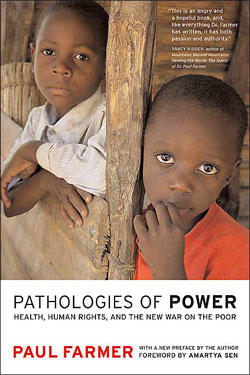
Pathologies of power: Health, human rights and the new war on the poor by Paul Farmer


Paul Farmer is a doctor of medicine. He has worked all over the world with the dispossessed, the sick, the dying and most of all with the poor. Farmer is among the few medical professionals who as well as giving his time to those who are less fortunate than us has set about to attack the institution that keep these "pathologies of power" in place. What Farmer gives us with this book is anecdotes of patients of his from all over the world as well as statistics that put the public health system in these countries to shame, and put the rest of us to shame as well for allowing this to go on.

Throughout this book, Farmer exposes the very institutions that benefit most from a health system that fails literally millions of people. He expresses frustration where an easily solvable problem in medical terms is unable to be solved because the appropriate drugs simply aren't available. Diseases such as tuberculosis, which are curable in the vast majority of cases with relatively inexpensive drugs. It is largely because these drugs are not available that medical professionals have seen a huge increase in the amount of cases of multi-drug-resistant TB. These are especially telling in prison populations, where often a prison sentence can also become a life sentence.

Furthermore, Farmer expands on this to confront why medical ethics courses largely stick to the plight of those with the fortune to be able to access the right drugs or even to be able to sign their rights away. He sees public health as essentially lacking even among organisation such as the World Health Organisation. More than anything this book stands as a call to action for those of us who find it easier to turn a blind eye. It is both personal with a large amount of anecdotes and statistically sound in its reproduction of the plight of people all over the world.